Design Notes
The Story Behind Each Piece
Every design begins in the archive. Below, the histories, myths, and ancient symbols that shaped this collection.
Select a piece to read its story
-
Marquise of Horus Pendant
Regular price $2,500.00 USDRegular priceUnit price / perSale price $2,500.00 USD -
Bereka Pendant
Regular price $1,900.00 USDRegular priceUnit price / perSale price $1,900.00 USD -
Tuareg Guardian Hoops
Regular price $1,500.00 USDRegular priceUnit price / perSale price $1,500.00 USD -
Tibeb Shield Pendant
Regular price $1,900.00 USDRegular priceUnit price / perSale price $1,900.00 USD -
Tibeb Shield Signet
Regular price $4,700.00 USDRegular priceUnit price / perSale price $4,700.00 USD -
Meskel Ring
Regular price From $2,300.00 USDRegular priceUnit price / perSale price From $2,300.00 USD -
Marquise of Horus Ring
Regular price $7,500.00 USDRegular priceUnit price / perSale price $7,500.00 USD -
Eternal Mother Pendant
Regular price $1,900.00 USDRegular priceUnit price / perSale price $1,900.00 USD
MARQUISE OF HORUS RING
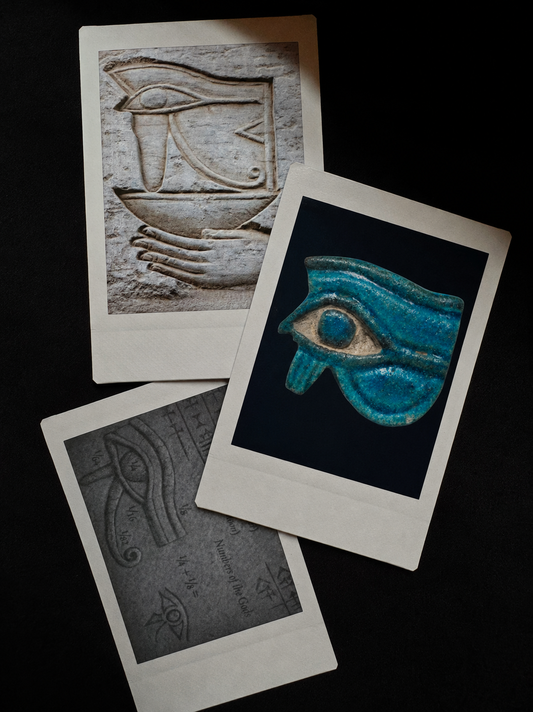
Horus lost his left eye in battle with Set while avenging his father Osiris. Thoth restored it, and the restored form was called the wedjat, the whole one. The left eye was read as the moon and the right as the sun, so the wound and its healing were watched in the sky every month.
Egyptians wore the wedjat as an amulet against harm and misfortune. It was carved into tomb walls and worn on the body for close to three thousand years.
We designed it to look excavated, as though it had come out of a tomb rather than off a bench. The gold is sculpted and organic, and the marquise stone set as the eye.
It is worn as a statement ring or as a wedding ring, by men or women who want a eye-catching, unique design that has a long history of protection symbolism behind it.
ETERNAL MOTHER PENDANT
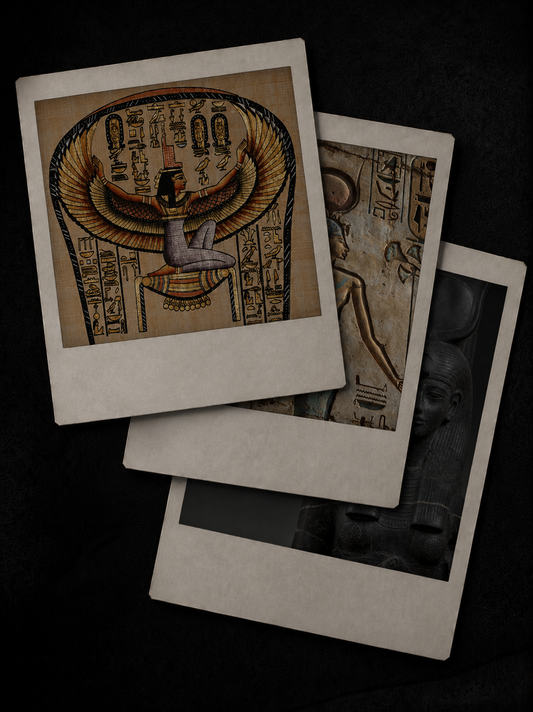
Aset (referred to as Isis by the Greeks) was worshipped in Egypt for over three thousand years and her following later spread across the Mediterranean. She appears throughout Egyptian art as a kneeling figure with her wings spread, a protective posture carved onto sarcophagi and tomb walls to shelter the dead.
The story behind that posture is the oldest one Egypt told. When Set murdered Osiris and scattered him, it was Aset who searched the length of the country, gathered what was left, and put him back together. She was the most skilled magician among the gods, and she used that skill to restore her husband and to conceive their son. She raised Horus alone in the marshes of the Delta, hidden from the man who had killed his father, and when a scorpion struck the boy she healed him herself. Every protective symbol Egypt produced traces back through her hands.
Her worship absorbed and was absorbed by other figures over time, including Hathor in Egypt, and Venus and Aphrodite in the Roman world. Her temple at Philae was still receiving worshippers into the sixth century, long after the rest of Egypt's gods had gone quiet. Nothing outlasted her.
This pendant takes that winged kneeling form and reduces it to a single sculpted disc. The crown references the horned solar headdress she is shown wearing in later depictions. Her kneeling posture is creation. Her uplifted wings are invocation.
This was the first piece Amora Adera made, and it remains the one the house is built around.
A modern relic for those who remember that feminine divinity lives in us across time.
MESKEL RING
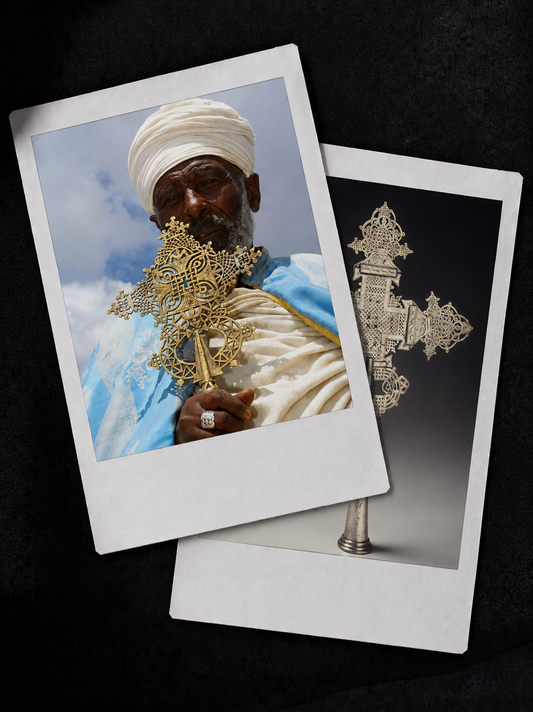
Meskel is the Amharic word for cross. Ethiopian crosses are built from interwoven latticework, a tradition in which a single line is folded back through itself until the pattern closes with no beginning and no end. No two are alike. Each Ethiopian region has it's own recognizable cross style.
This ring translates that geometry into a band. The pattern is cut into the face rather than applied to it, so the lattice reads as part of the metal, the way the churches at Lalibela were cut down into the rock rather than built up from it.
Meskel is also the name of a festival held every September, the oldest continuously observed holiday in the country, where those crosses are carried in procession. The metalwork in them is so intricate that they are unmistakably Ethiopian.
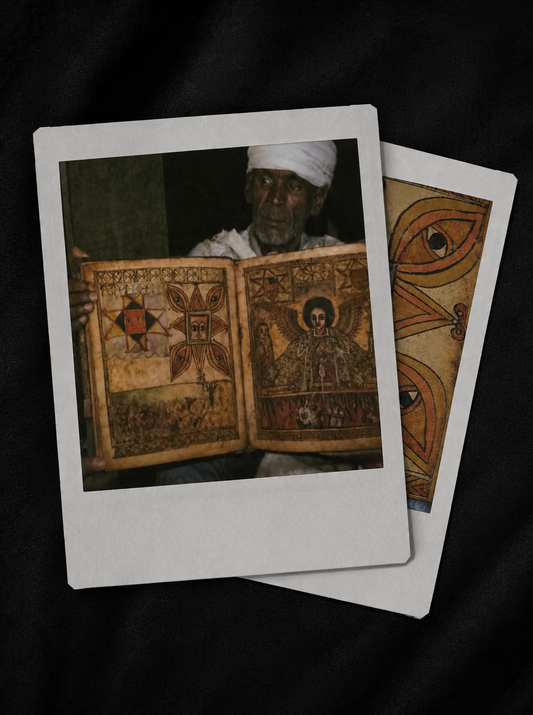
TIBEB SHIELD SIGNET
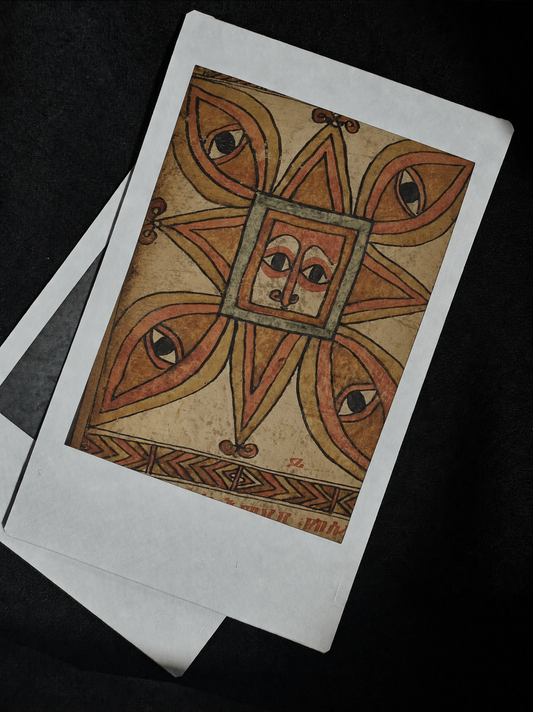
The diagrams in Ethiopian healing scrolls are built to a strict geometry. Eight points radiate from a center, referencing the wings of four guardian archangels, and four eyes are set into the design as watchers, a motif tied to vigilance in Ethiopian sacred art. The eye reads the same way here as it does across the Mediterranean and North Africa: something that looks back at what it is guarding against.
These were made by revered Ethiopian spiritual scholars, drawn for one person and meant to stay with them.
A signet is worn outward, facing the world rather than the wearer. This one carries the diagram in solid gold, the four stones set as the watchers, reimagined as a modern heirloom of protection.
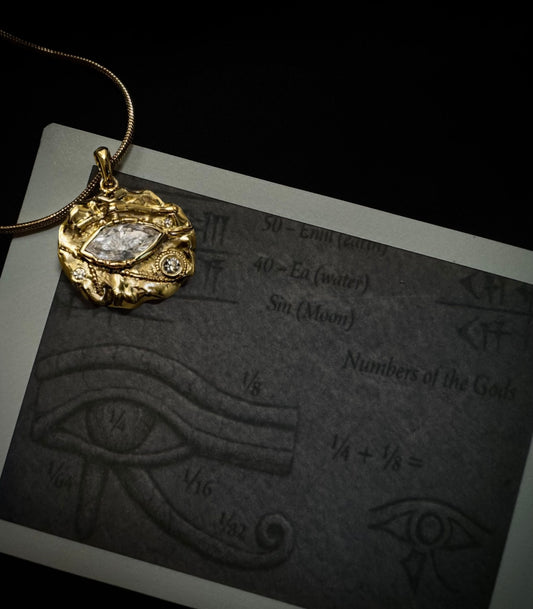
MARQUISE OF HORUS PENDANT
Horus lost his left eye in battle with Set while avenging his father Osiris. Thoth restored it, and the restored form was called the wedjat, the whole one. Egyptians wore it as an amulet against harm, misfortune, and the evil eye.
The eye was also read as six parts, each tied to a sense and to a unit fraction. The inner corner is smell at 1/2. The pupil is sight at 1/4. The eyebrow is thought at 1/8. The left side is hearing at 1/16. The curved tail is taste at 1/32. The teardrop is touch at 1/64.
Together those fractions total 63/64 rather than a complete whole. The missing part stands for divine completion, healing, and sacred restoration, the piece that comes from outside the self. In designing this pendant we sought to honor those ancient proportions as closely as possible, and with them the eye's associations with protection, healing, balance, and renewed wholeness. The eye is set as a single marquise stone rather than a drawn line.
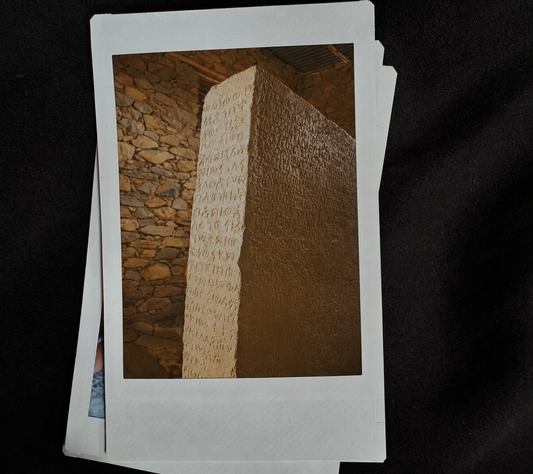
BEREKA PENDANT
“May blessing endure for all eternity. Amen.”
ālemi le’ālemi lezele’ālemi āmēni, bereket
አለም ለአለም ለዘለአለም አሜን - በረከት
The kingdom of Aksum recorded itself in stone. The Ezana Stone, raised in the fourth century, carries a royal inscription cut in Ge'ez alongside Greek and Sabaean. The Ethiopian Amharic script on this pendant reflects this same historical style. The Amharic prayer on the pendant is laid out in a figure eight so the blessing reads without beginning or end, and the surface is left rough, closer to worked stone than polished gold.
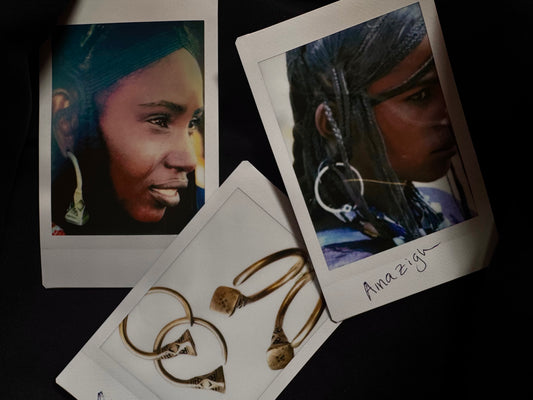
TUAREG GUARDIAN HOOPS
The Tuareg are an Amazigh people of the central Sahara, in Niger, Mali, Algeria, and Libya, whose caravans carried the trans-Saharan trade north into Morocco for centuries. Their silverwork is made by hereditary smiths who hold the designs within their families, and the forms carry meaning that is read rather than decorative.
These hoops reinterpret a historic protective form through a fine-jewelry lens. The pointed ends, drawn from traditional earring silhouettes known as elkiss or eraf wa n tesabit, have long been associated with protection against the evil eye, misfortune, and illness.
This design preserves the original engraved character and distinctive pointed shape of the source form, while refining the scale into a more delicate, elevated version suited to modern luxury wear. The result is a piece that honors the cultural symbolism and anthropological significance of the original design while offering a sculptural, wearable expression of protection and prosperity.
TIBEB SHIELD PENDANT
Ethiopian healing scrolls were made by church-trained scribes. A scroll was written for one named person and cut to that person's height, so the object matched the body it was made for. Some were hung in the home. Others were rolled into a leather case and worn around the neck.
The scrolls carry geometric diagrams meant to guard the owner against illness and misfortune, built around eye motifs that appear across the Mediterranean and North Africa in the same protective role.
This pendant takes that form off the parchment and into gold. The eight-point structure references the wings of four guardian archangels, while the four stones are placed as symbolic watchers, a motif associated with vigilance and spiritual safeguarding in Ethiopian sacred art.